 English

Suit Jacket Fabric Guide: Choosing the Right Material for Fit, Durability, and Cost
Stretch the fabric over your hand and watch how it falls at the edge. Crush a corner, wait ten seconds, and release it. These two movements reveal more about a suit jacket fabric than most technical datasheets, and they are the first checks we run when a customer asks us to develop a new jacket style.
The reason is simple: a jacket demands more from its material than a trouser or a shirt. It must roll smoothly over the shoulder, hold a sharp lapel crease, absorb repeated strain at the elbows, and still look clean after a full day of wear. Choosing the right suit jacket fabric is therefore a balance between drape, recovery, weight, and wrinkle resistance, and the final decision usually comes down to fiber composition and the stretch structure woven into the cloth.
This guide explains those decisions in practical terms, with the test methods and buying criteria that matter at the sampling stage.
What a Suit Jacket Fabric Must Deliver
Before comparing fibers and weaves, define the job the jacket has to do. Most tailored jackets fall into three zones: structured business wear, relaxed unlined blazers, and uniforms or service wear. Each zone changes the priority list.
For structured business wear, drape and recovery come first. The fabric must hold its shape through the shoulder pad and canvas, then return to form after hours of sitting or driving. Woven construction is non-negotiable here, because a woven cloth has the dimensional stability that a knitted fabric cannot offer when it is repeatedly stretched and released. If you are evaluating both options, our comparison of woven versus knitted construction explains why tailoring depends on the woven structure.
Uniforms and service jackets put durability and color fastness at the top. These garments are cleaned frequently, worn in demanding environments, and must keep a consistent appearance across production batches. In this zone, polyester-rayon blends dominate because they combine strength, stable color, and a realistic budget per meter.
The common thread across all three zones is that the fabric has to work with the tailoring, not against it. A beautiful cloth that fights the interlining or bags out at the elbows will fail in production, no matter how premium it looks on the roll.
Fiber Composition and What It Actually Changes
Fiber composition is the biggest lever you control at the fabric selection stage. It drives hand feel, recovery, breathability, care behavior, and price. The table below summarizes the options that appear most often in suit jacket programs.
| Composition | Strengths | Trade-Offs | Best Suited For |
|---|---|---|---|
| 100% wool | Superior drape, natural recovery, moisture absorption | Higher cost, dry cleaning usually required, warm in summer weights | Classic tailored suits, cooler climates |
| Wool-polyester-viscose blend | Balanced hand, shape retention, can be engineered with stretch | Less pure-wool feel, quality varies with wool percentage | Year-round suiting, travel jackets |
| Polyester-rayon with spandex | Wrinkle resistance, color fastness, cost efficiency, consistent supply | Less breathable than wool, finishing quality is critical | Uniforms, high-volume orders, commuter jackets |
| Cotton or linen | Cool hand, casual character, natural appearance | Heavy creasing, weak recovery, limited structure | Summer blazers, unstructured jackets |
The most practical way to close the gap between budget and performance is a polyester-rayon base with spandex. This combination gives a jacket structure and wrinkle resistance at a fraction of the cost of pure wool, and modern finishing has improved the hand feel considerably. Our dyed poly-rayon stretch suiting collection is built on exactly this principle, with top-dyed and yarn-dyed versions for designers who need color depth or pattern without sacrificing performance.
Two-Way vs Four-Way Stretch in a Jacket
Stretch is where suit jacket fabric selection gets technical. The industry works with two basic options: two-way stretch, usually running along the weft (the crosswise direction), and four-way stretch, which extends along both the warp and the weft. The diagram below shows the difference at a glance.
For a structured jacket, two-way stretch is usually enough. It lets the shoulders and elbows yield slightly without weakening the panel, which keeps the lapel and chest line stable through the day. Four-way stretch suits slim-fit silhouettes, unlined jackets, and designs where the fabric moves directly with the body.
Stretch recovery is the detail that separates a good stretch fabric from a poor one. A fabric that stretches 15 percent but keeps 5 percent of that elongation after release will produce a jacket that bags at the elbow within a few wears. When we develop suit jacket fabrics, we test both stretch percentage and recovery under repeated cycles. That is why our wrinkle-resistant poly-rayon four-way stretch crepe is a common choice for commuter jackets: it combines recovery with a matte surface that hides daily wear.
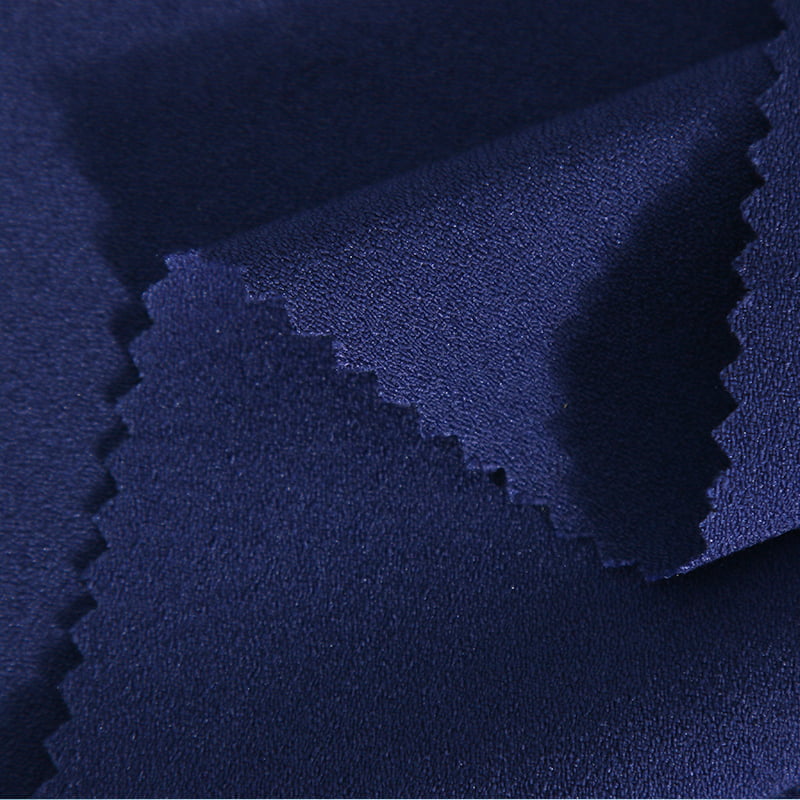 FX50226 Reactive Dyed Wrinkle Resistant Poly Rayon 4 Way Stretch Crepe Fabric FoShaoxing Fuxing Textile Technology Co., Ltd is a China OEM FX50226 Reactive Dyed Wrinkle Resistant Poly Rayon 4 Way Stretch Crepe Fabric ...View Product →
Weight, Weave, and Pattern: Matching the Fabric to the Jacket Style
Weight ranges that cover most jacket programs
- 180-220 gsm - light and airy; ideal for warm-weather blazers and travel suits, but it needs careful interlining to keep the shoulder shape.
- 220-280 gsm - the year-round standard; supports structured tailoring without feeling heavy, and works for both menswear and womenswear.
- 280-350 gsm - winter suiting and light outerwear territory; holds a strong silhouette and adds warmth.
For the lighter end of this range, the spring-summer poly-viscose-wool blend with four-way stretch is one of our most requested options because it keeps a tailor-friendly hand without the heaviness of a winter cloth.
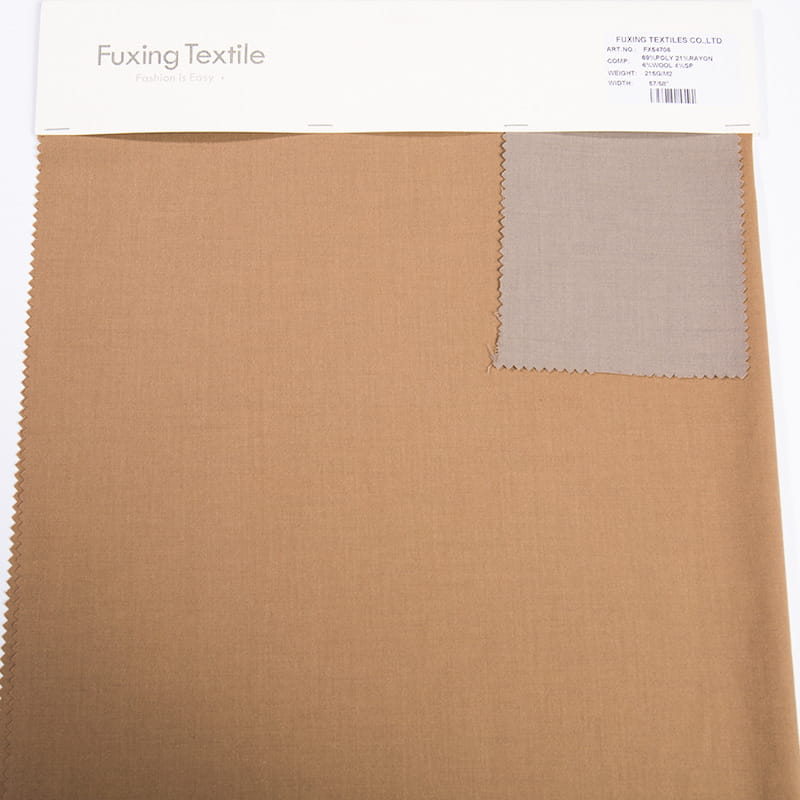 FX54706 Spring/Summer Soft Handfeeling Polyester Viscose Wool Blend 4 Way StretcShaoxing Fuxing Textile Technology Co., Ltd is a China OEM FX54706 Spring/Summer Soft Handfeeling Polyester Viscose Wool Blend 4 Way Stre...View Product →
Weave structures worth knowing
- Twill - the workhorse of suiting. Durable, drapes well, and hides wrinkles on the diagonal structure.
- Crepe - matte, slightly textured surface that flexes with movement; excellent for unlined or semi-structured jackets.
- Double weave - two layers in one cloth, giving stability and warmth; suited to structured coats and winter jackets.
- Herringbone - a twill variation that adds visual depth while keeping the same tailoring behavior.
Patterns built into the cloth
For check, stripe, and houndstooth jackets, yarn-dyed construction colors the warp before weaving, which gives patterns sharp edges and longer color life than piece-dyed alternatives. The pattern is woven through the fabric rather than printed on the surface, so it survives repeated cleaning. A good example is our yarn-dyed houndstooth poly-rayon spandex suiting, developed for designers who need a traditional pattern with modern stretch and easy care.
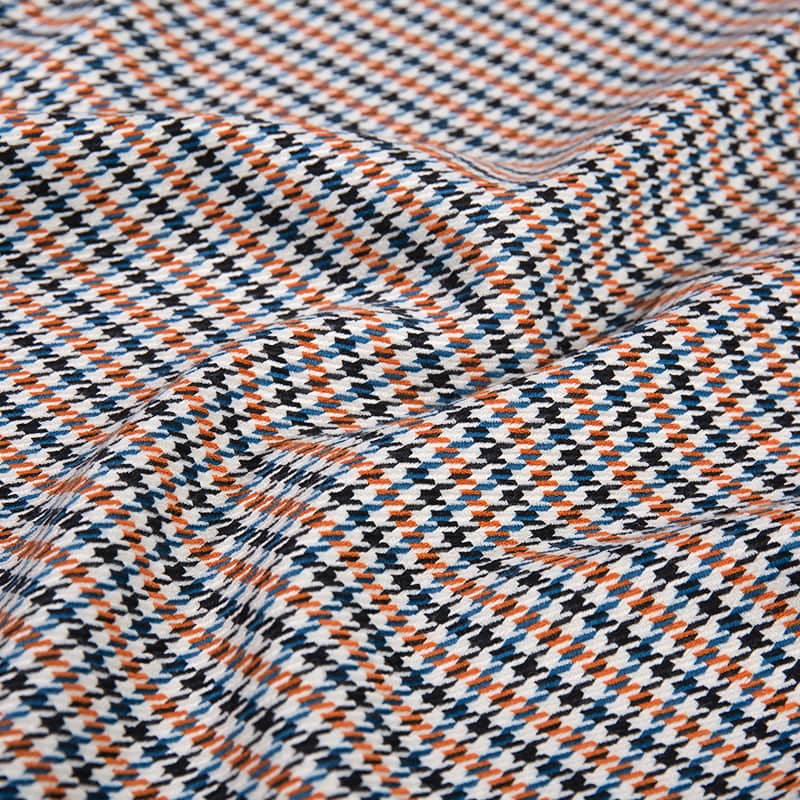 FX54372 Yarn Dyed Customize Houndstooth Design Poly Rayon Spandex Woven Fabric FShaoxing Fuxing Textile Technology Co., Ltd is a China OEM FX54372 Yarn Dyed Customize Houndstooth Design Poly Rayon Spandex Woven Fabric...View Product →
How to Evaluate a Suit Jacket Fabric Before You Commit
Before placing a bulk order, run every candidate through the same five checks. Together they take about five minutes per swatch, and they catch most of the problems that only appear after sewing.
- Drape test. Hold the fabric at one corner and let it fall. A good jacket cloth forms clean folds; a stiff board-like fabric will not tailor well.
- Crease recovery. Crush the fabric in your fist for ten seconds, then smooth it out. Count how quickly the creases relax. Fast recovery means the jacket will still look fresh at the end of the day.
- Stretch and return. Pull along the weft and the warp, hold for five seconds, and release. Measure how far the fibers settle from the original point. Permanent elongation above 3 percent is a red flag.
- Surface check. Run your thumbnail lightly across the face and the back. Snagging or fuzzing here will only get worse after sewing and washing.
- Shrinkage and color fastness. Ask for a pre-production swatch in the actual shade you intend to order, then wash, dry, and press it according to your planned care label. This is the only reliable way to validate both shrinkage and color stability.
These checks matter most for stretch suitings, because elasticity changes how the fabric reacts to heat, moisture, and repeated wear. A supplier that controls the finishing stage will always perform better in these tests, which is why we run the same checks in-house before any bulk order leaves our mill.
Care, Sewing, and Long-Term Performance
Spandex is sensitive to high heat. Pressing a stretch suiting above roughly 150 degrees Celsius can degrade the elastic fiber, so the care label should specify a low iron temperature and dry cleaning where appropriate. This is the most common cause of jackets that lose their fit after the first season.
Stretch fabrics also change the rules in the sewing room. The needle type, thread tension, and seam construction all need adjustment for elastic yarns, and seam puckering is a recurring issue when the machinery is not calibrated. We have summarized the common sewing challenges with stretch suiting so that production teams can avoid the usual mistakes.
For buyers, a fabric that looks good on the roll earns its keep only if it survives production, transit, and daily use. This is why we test for pilling, color fastness, and dimensional stability before the fabric is packed. The buying decision should include those tests, not just the price and the hand feel.
Put together, the right choice comes from matching the jacket's role to a composition and stretch structure that can actually deliver it. Weight, recovery, and wrinkle resistance are the three numbers to pin down before any other feature is discussed.
Frequently Asked Questions About Suit Jacket Fabric
What is the best fabric for a suit jacket?
There is no single answer. For year-round tailored suits, a wool or wool-polyester-viscose blend around 220-280 gsm is the safest choice because it balances drape, recovery, and seasonality. For uniforms and daily commuter jackets where easy care matters more than a pure wool feel, a well-finished polyester-rayon stretch suiting delivers better value and a longer appearance life.
Is polyester-rayon stretch fabric good enough for a suit jacket?
Yes, when the finishing is done properly. A T/R stretch fabric with spandex gives the jacket structure, color fastness, and wrinkle resistance at a significantly lower cost than wool. It is widely used in uniforms, corporate wear, and travel jackets. The critical points to verify are stretch recovery, surface finishing, and shrinkage control, all of which can be checked with the five tests described above.
What does four-way stretch mean in a suiting fabric?
It means the fabric stretches along both the warp, or lengthwise, and the weft, or crosswise, directions. A two-way stretch fabric extends in only one direction, usually the weft. Four-way stretch follows the body more closely and suits slim silhouettes and unlined jackets, while two-way stretch preserves more of the tailored structure.
What weight should a suit jacket fabric be?
The 220-280 gsm range is the standard for year-round jackets. Below 220 gsm the fabric suits summer or unstructured blazers but needs careful interlining to keep the shoulder line. Above 280 gsm the fabric gains warmth and structure, which fits winter suiting and light outerwear.
- How does the 45% POLY (polyester fiber) in Fashion Tr Poly Rayon Spandex With Linen Top Dyed Suiting Fabric contribute to the overall performance?
- How Does the Stretch Feature of Dyed Poly Rayon Woven Fabric Improve Fit and Style?
- How Does Dyed Poly Rayon Woven Fabric With Stretch Improve Comfort and Durability in Apparel?
- How Can Dyed Poly Rayon Woven Fabric With Stretch Be Used to Enhance the Fit and Flexibility of Garments?

Choose Us, Contact Us
-

Tel: +86-575-81176657
+86-18857538666 -
 E-mail: martin@fuxing-tex.com
 -
 Xindian Village, Qianqing Street, Keqiao District, Shaoxing City, Zhejiang Province, China.
Copyright © Shaoxing Fuxing Textile Technology Co., Ltd. All rights reserved.
