 English

Men's Suit Fabrics Guide: Wool, Linen, Cotton, Stretch Blends and Weaves
For a men's suit, worsted wool is still the benchmark cloth — nothing matches its drape and recovery — but it is no longer the only sensible answer. Wool-stretch blends, T/R (polyester-rayon) suiting, linen, and cotton each cover a different balance of breathability, wrinkle resistance, and cost, and the right choice depends on where and how often the suit will actually be worn.
Before comparing swatches, fix three variables: the season the suit is for, the fabric weight your tailoring line can handle, and how much daily movement the cloth needs to forgive. Answer those first, and the shortlist usually drops to two or three fabrics. The sections below cover the main families, the weight logic, the weaves that change the look, and a five-step check to run before you commit to bulk.
The Core Fabric Families for Men's Suits
Most men's suiting falls into five families, and each earns its place through a specific strength rather than prestige alone. Worsted wool leads on drape and recovery, with finer yarns (Super 100s and above) feeling progressively silkier. Linen and cotton solve heat and budget respectively, flannel and tweed handle the cold, and stretch blends — the fastest-growing category for daily business wear — trade a little tradition for a lot of practicality.
| Fabric family | Typical season | Key strengths | Watch-outs |
|---|---|---|---|
| Worsted wool | Year-round | Best drape and recovery; tailors cleanly; breathes well | Highest cost; needs careful cleaning |
| Wool-T/R stretch blend | Year-round, heavy wear | Soft hand; 2-way or 4-way stretch; resists wrinkles | Recovery varies between batches |
| Linen | Peak summer | Strongest airflow; crisp, relaxed texture | Creases quickly; too casual for strict dress codes |
| Cotton | Spring, smart-casual | Breathable, affordable, easy care | Little structure; reads casual |
| Flannel / tweed | Autumn, winter | Warmth, surface texture, deep color | Heavy; too warm for mild days |
Where stretch blends fit in
Stretch blends earn their shelf space in corporate wear, uniforms, and any suit that commutes. Polyester brings dimensional stability and wrinkle resistance, rayon contributes a soft hand and moisture absorption, and a small elastane share adds the give that plain wool lacks. The result survives a full working day and a long flight without looking exhausted. For buyers, the decisive test is recovery: stretch the cloth, release it, and it should snap back without bagging. Poly-viscose-wool constructions are the usual middle ground when a client wants a wool look with easier day-to-day care.
One example built for warmer months is a four-way stretch poly-viscose-wool suiting with a soft hand:
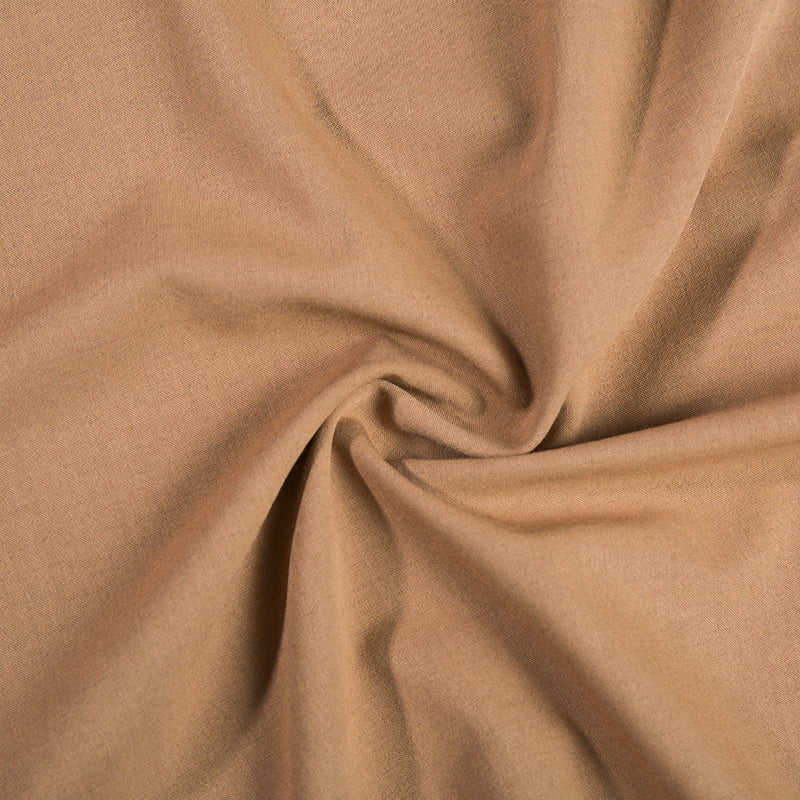 Poly-Viscose-Wool Four-Way Stretch Suiting for Spring and SummerA soft-hand poly-viscose-wool blend with four-way stretch, drape, and wrinkle resistance, fitting the lightweight 7-9 oz band discussed for warm-weather suits, trousers, and shirts.View Product →
Matching Fabric Weight to the Season
Weight decides comfort more than fiber choice does. Suiting is sold by ounces per running yard or grams per square meter (GSM), and the rough bands are well established: about 7-9 oz (240-305 GSM) for hot weather, 9-11 oz (305-375 GSM) as the year-round standard, and 12 oz (roughly 410 GSM) upward for genuine winter cloth. Lighter is not automatically better — an ultra-light fabric can cling and show every crease, while a true mid-weight holds the garment's line through a long day. Match the number to the wearing scenario, not the marketing label.
Linen or open-weave tropical wool at 7-9 oz. Choose airflow first and accept a relaxed, creasing look.
T/R or wool-T/R stretch at 9-10 oz. Wrinkle recovery matters more than surface sheen.
Worsted wool or T/R stretch at 9-11 oz. Balance structure, comfort, and easy pressing.
Flannel, tweed, or heavy top-dyed blends at 12 oz and up. Texture and warmth over lightness.
For winter programs, heavy top-dyed poly-viscose suitings deliver depth of color and warmth at a controllable cost — a typical example:
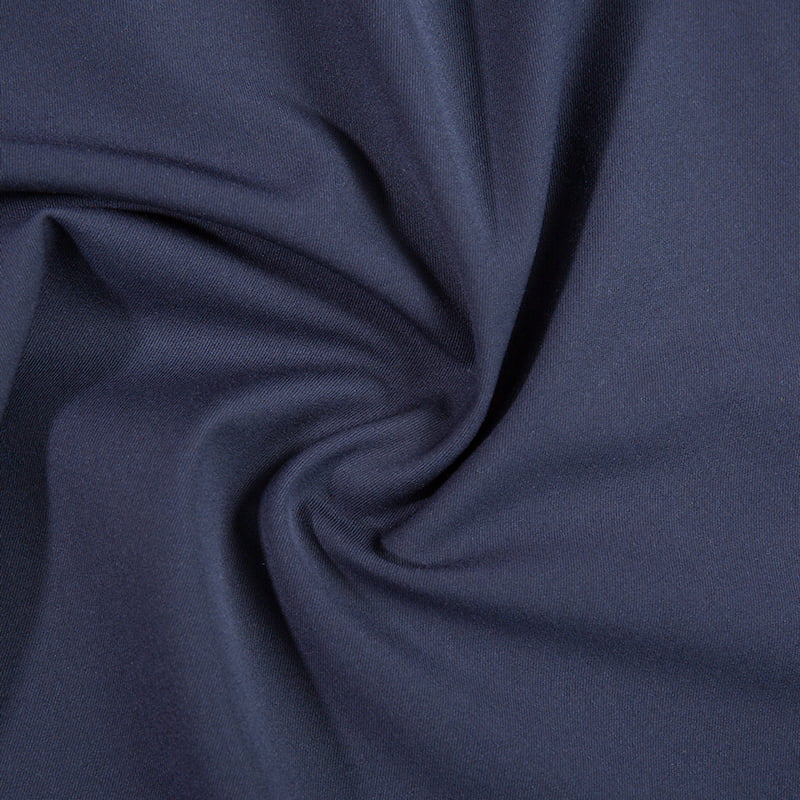 Heavyweight Top-Dyed Poly Viscose Stretch Suiting FabricA firm, elastic poly-viscose suit fabric with stretch and wrinkle resistance, illustrating the heavier winter-weight cloth described above, suited to suits, trousers, and uniforms at controllable cost.View Product →
Weaves and Patterns That Change the Look
Two weave families do most of the work in suiting. Twill, with its diagonal ridges, drapes better, resists wrinkling, and hides soil — which is why it dominates business suiting. Plain weaves such as birdseye, nailhead, and open tropical weaves are crisper and breathe more freely, making them the warmer-month choice. If you want the twill side broken down in detail, our guide to what is twill suit fabric explains how the weave structure changes drape and durability.
Pattern is a yarn decision, not a print decision. In yarn-dyed cloth, colored yarns are woven into herringbone, houndstooth, glen checks, and stripes, so the design is part of the cloth itself and survives years of cleaning instead of sitting on the surface. That is why a houndstooth keeps its edges sharp: the contrast is structural, and the same logic applies to checked and striped uniform cloth that has to hold its look for seasons.
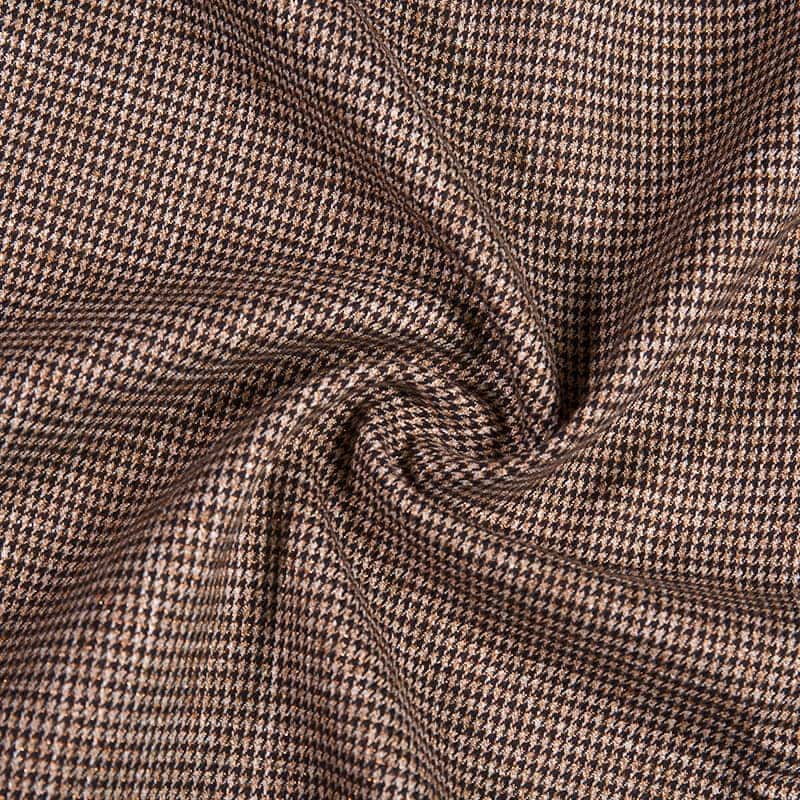 Yarn-Dyed Houndstooth Poly Rayon Spandex Fabric for Suits and UniformsA stretch, wrinkle-resistant poly-rayon-spandex woven with customizable yarn-dyed houndstooth, showing how woven-in patterns keep edges sharp through repeated cleaning in suits and uniforms.View Product →
A Five-Step Check Before You Commit to Bulk
Run these five checks on any candidate fabric, and most sourcing problems surface before production starts.
- Read the composition label. Fiber percentages, elastane share, and weave name tell you more than any color card. A 65/35 polyester-rayon with a small elastane content will press, stretch, and age very differently from a 90/10 wool blend at the same weight.
- Crush it in your fist. Squeeze the cloth for about ten seconds and let go. Quality suiting recovers within seconds; creases that stay put signal weak resilience and a garment that looks tired by mid-afternoon.
- Check the weight against the season. Get the GSM or ounce figure in writing. Stretch wovens often feel lighter than they measure, and a cloth chosen too warm for its climate simply goes unworn.
- Test stretch and recovery. Pull a corner gently and release it. The cloth should snap back without ripples, and stretched seams should return flat. Bagging at the knees and elbows is the classic failure of poorly engineered stretch blends.
- Ask how the color was applied. Piece-dyed, top-dyed, and yarn-dyed fabrics differ in color depth and batch-to-batch consistency. For bulk orders, insist on swatches cut from the actual production lot rather than the showroom book.
These five checks remove most of the guesswork from sourcing. For swatches, roll specifications, or a custom development brief, you can reach the team through the contact page.
Frequently Asked Questions
References
- Established tailoring and menswear construction guides
- Public textile education resources on fiber, weave, and dyeing properties
- What is the composition ratio of FX54706 Spring/Summer Soft Handfeeling Polyester Viscose Wool Blend 4 Way Stretch Suiting Fabric? What are the advantages of such a ratio?
- What types of clothing are suitable for FX55425 Manufacture Tr 4 Way Stretch Top Dyed Fabric For Men'S Suit Trousers?
- What Are the Key Differences Between Dyed Poly Rayon Woven Fabric With Stretch and Other Stretch Fabrics?
- How does Colorful Polyester Rayon Stretch Wool Fabric balance fashion and performance?

Choose Us, Contact Us
-

Tel: +86-575-81176657
+86-18857538666 -
 E-mail: martin@fuxing-tex.com
 -
 Xindian Village, Qianqing Street, Keqiao District, Shaoxing City, Zhejiang Province, China.
Copyright © Shaoxing Fuxing Textile Technology Co., Ltd. All rights reserved.
