 English
 中文简体
 日本語
 한국어
 русский
 Español


Twill vs Crepe vs Herringbone: Weave Differences in Suiting Fabric
The Short Answer
Twill has a straight diagonal rib, crepe has a pebbled and textured surface, and herringbone is a twill whose diagonal reverses direction to make a zigzag. The three behave differently in a suit: twill gives structure, crepe gives drape and hides creases, and herringbone gives a classic tailored look with visual depth. Which one is right for women's suiting depends on the garment, the season and the finish you want.
Weave Comparison at a Glance
| Feature | Twill | Crepe | Herringbone |
| Surface | Diagonal rib | Pebbled, matte texture | V-shaped zigzag rib |
| Look | Clean, tailored | Soft, textured, relaxed | Classic, patterned, visual depth |
| Hand and drape | Supple and structured | Soft with good drape | Structured, with a sense of drape |
| Hides creases | Moderately | Well, due to the texture | Moderately |
| Typical use | Pants, blazers, suits | Suits, trousers, outerwear | Autumn and winter suits |
| Fuxing example | FX50388, FX54218 | FX50226, FX50182 | FX54869 |
Twill: Structure and Everyday Strength
Twill is built by passing the weft over one yarn and under two or more, then shifting the pattern one step each row to create a diagonal line. That construction is dense and durable, and it gives garments a clean, structured look that holds a line at the hem and the lapel.
FX50388 polyester viscose twill
265 GSM, 65% polyester, 32% rayon and 3% spandex. Described as moderate body, wrinkle-resistant and easy to maintain, for pants and blazers.
FX54218 double-weave twill
280 GSM, 74% polyester, 20% rayon and 6% SP. A double-layered organization with 4-way stretch and good drape.
Crepe: Texture, Drape and Easy Wear
Crepe fabrics have a rough, pebbled surface instead of a smooth rib. That irregular surface scatters light and hides small creases, which makes crepe a good choice for garments worn through a long day. Crepe also drapes well, so it falls softly instead of standing away from the body.
The range includes FX50226, a 75% polyester reactive-dyed crepe at 200 GSM with 4-way stretch, and FX50182, a plain-dyed TR suiting crepe at 220 GSM described as light, balanced and suited to women's outerwear. The product pages name crepe but do not specify how the texture is formed, so the surface notes here are general crepe behavior.
Herringbone: A Twill With a Twist
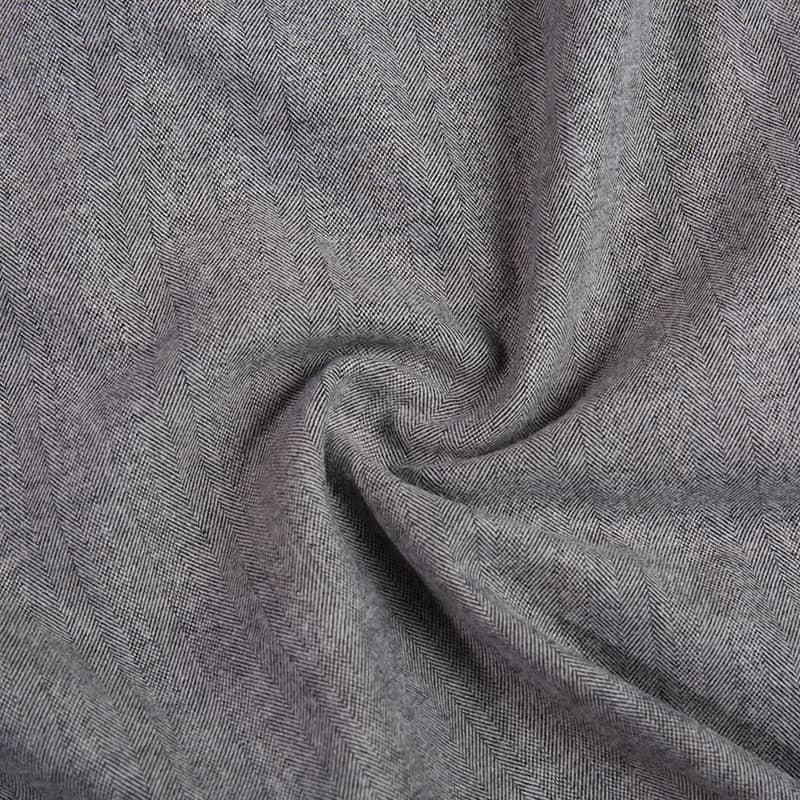
Herringbone is a broken twill: the diagonal runs one way, then reverses, so the surface forms a row of V shapes that resembles the bones of a fish. It adds pattern and depth without printing, which is why herringbone is a long-standing classic in tailoring.
FX54869 is a herringbone heavy-weight poly viscose wool blend at 310 GSM. Its composition is 62% polyester, 28% rayon, 8% wool and 2% spandex, and the page describes it as wrinkle-resistant, warm and breathable, for autumn and winter suiting. The page title mentions cashmere, but the listed composition has no cashmere.
Weight, Season and Fiber Compared
| Fabric | Weave | Composition | Weight | Best Season |
| FX50226 | Crepe | 75% poly, 20% rayon, 5% SP | 200 GSM | Year-round indoor wear |
| FX50182 | Crepe | 65% poly, 30% rayon, 5% spandex | 220 GSM | Spring and autumn |
| FX50388 | Twill | 65% poly, 32% rayon, 3% spandex | 265 GSM | Spring to autumn |
| FX54218 | Double-weave twill | 74% poly, 20% rayon, 6% SP | 280 GSM | Spring to autumn |
| FX54869 | Herringbone | 62% poly, 28% rayon, 8% wool, 2% spandex | 310 GSM | Autumn and winter |
The product pages state autumn and winter for the 310 GSM item and spring and autumn outerwear for FX50182. The remaining season notes are an interpretation of the weight and should be confirmed for your market.
Working With Each Weave in Garment Making
The weave you choose also changes how the fabric behaves at the cutting table and on the sewing line. These are general tailoring points, not product claims, but they help when you plan a collection.
| Step | Twill | Crepe | Herringbone |
| Cutting | Cut along the grain so the diagonal runs true | Relaxes easily, so cut with care and let it rest | Align the V pattern at seams and centers |
| Sewing | Takes a clean seam and holds pressing well | Textured surface hides small stitch variation | Pattern matching adds time and fabric |
| Pressing | Holds a crease line well | Press lightly to keep the texture | Press gently so the rib is not flattened |
| Fabric use | Standard marker efficiency | Standard marker efficiency | Extra allowance for matching |
If you are running a large order, ask the mill for a lay test or a pre-production sample before committing, especially for herringbone where pattern matching affects fabric consumption.
Matching Weave to Garment
Twill or herringbone for structure. FX50388 and FX54218 are described for blazers and suits, and FX54869 for autumn and winter suiting.
Twill or crepe. Twill holds a crease line, while crepe drapes softly and hides wear.
Crepe for lighter coats and jackets. FX50182 is described as suited to spring and autumn outerwear.
Common Mistakes When Choosing a Suiting Weave
- Choosing by look alone. A herringbone swatch can look perfect and still be too heavy for a spring range.
- Ignoring fiber content. Two twills can differ widely in polyester, rayon and spandex, which changes recovery and feel.
- Skipping the drape test. Hold the swatch up and let it hang. Drape matters as much as the weave name.
- Forgetting the finish. A wrinkle-resistant finish affects how the garment behaves in wear, so ask about it.
- Not testing a cut sample. Make one garment before you commit to bulk.
Each mistake is cheap to catch at the sample stage and costly after bulk production.
Fiber Content Matters as Much as Weave
The weave sets the look, but the fibers set the performance. All five fabrics here are polyester-rayon blends with spandex or an elastic component, and FX54869 adds 8% wool.
Polyester
The main fiber in all five, from 62% to 75%. It supports shape stability and wrinkle recovery.
Rayon
From 20% to 32%. It adds softness, drape and, per the FX54218 page, breathability and moisture absorption.
Spandex and wool
Spandex adds stretch, and wool in FX54869 adds structure and natural luster according to its page.
When two weaves look similar, compare the composition lines first. A few points of polyester or spandex can change how a suit feels after a day of wear.
How to Choose Between Twill, Crepe and Herringbone
Ordering Notes
- Samples: regular samples take 5 to 12 days, with the first sample free and shipping collect.
- Lead time: the product pages list 25 days for crepe and twill items and 35 days for FX54869.
- Dyeing: all five are plain dyed or reactive dyed.
- Customization: colors are customizable on the crepe and double-weave twill pages. Customization options are not stated for FX54869.
- MOQ: varies by item, so confirm the figure for your item and color before planning.
Browse the full women's suiting range or read our guide on how to choose suit fabric by season.
Frequently Asked Questions
What is the difference between twill and herringbone?
Herringbone is a type of twill. Plain twill has a diagonal rib in one direction, while herringbone reverses the diagonal to create a V-shaped zigzag.
Is crepe or twill better for women's suits?
Twill gives more structure for tailored blazers and trousers, while crepe gives softer drape and hides creases. Many ranges use both.
Does herringbone suit women's suiting?
Yes. It is a classic pattern used in tailoring, and FX54869 is a herringbone poly viscose wool blend for suits.
Which weave is best for hiding wrinkles?
Crepe usually hides creases best because of its textured surface, though polyester content and finish matter as much as weave.
Can I get swatches of each weave?
Yes. Samples are available, and you can request swatches of the crepe, twill and herringbone options to compare side by side.
- How does the 45% POLY (polyester fiber) in Fashion Tr Poly Rayon Spandex With Linen Top Dyed Suiting Fabric contribute to the overall performance?
- What is the composition ratio of FX54706 Spring/Summer Soft Handfeeling Polyester Viscose Wool Blend 4 Way Stretch Suiting Fabric? What are the advantages of such a ratio?
- How to optimize the breathability of Plain Dyed Polyester Rayon 4 Way Stretch Twill Fabric to meet diverse needs?
- Why Choose Woven Polyester Rayon Spandex Blend Stretch Suiting Fabric?

Choose Us, Contact Us
-

Tel: +86-575-81176657
+86-18857538666 -
 E-mail: martin@fuxing-tex.com
-
 Xindian Village, Qianqing Street, Keqiao District, Shaoxing City, Zhejiang Province, China.
Copyright © Shaoxing Fuxing Textile Technology Co., Ltd. All rights reserved.
